
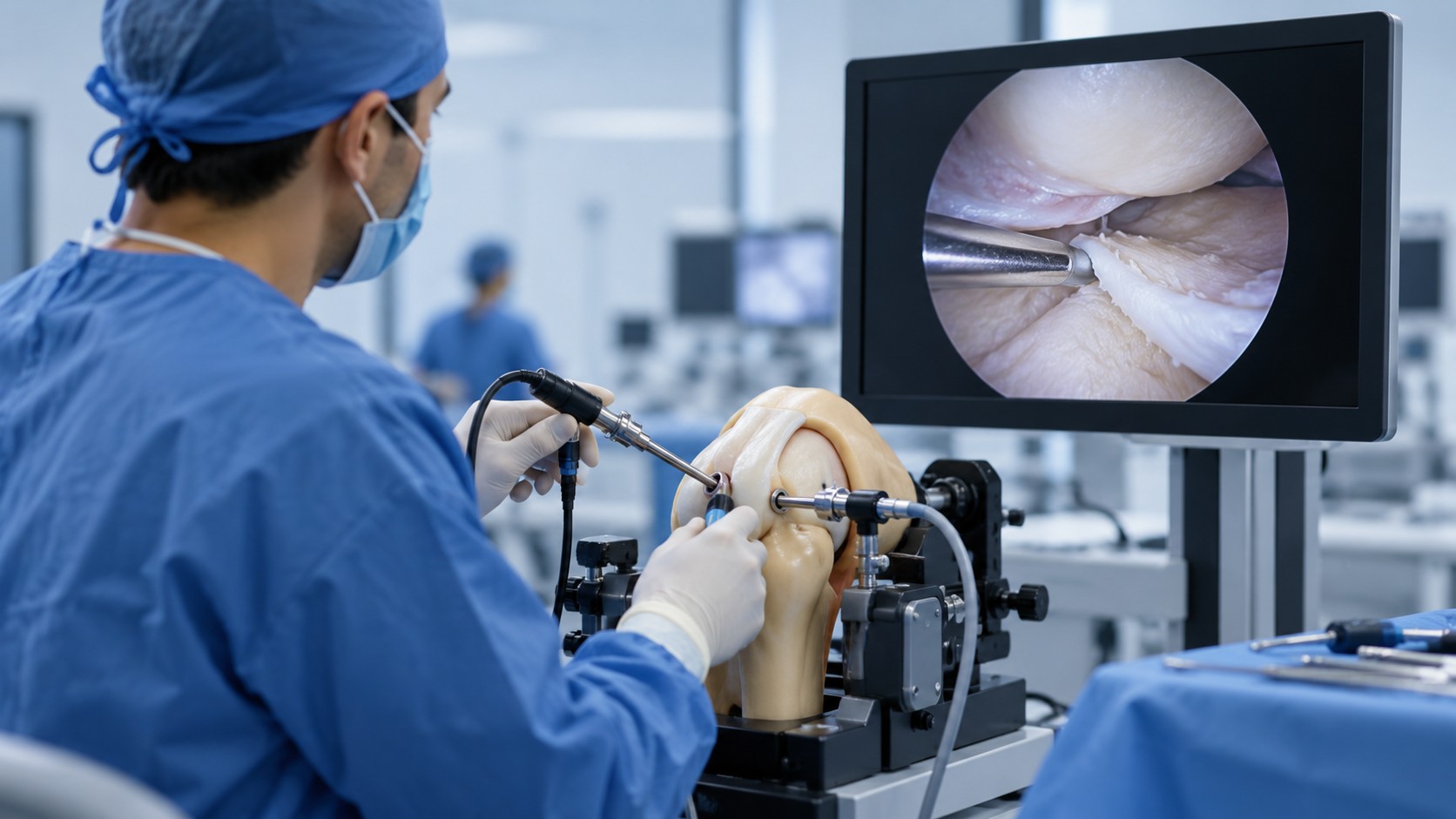
Arthroscopy Simulation Training: Building Confidence Before the Operating Room
Arthroscopic surgery asks orthopedic surgeons to operate through a keyhole, guided only by a two-dimensional monitor, while coordinating a scope in one hand and instruments in the other.
For clinicians pursuing arthroscopy simulation training, the gap between theoretical knowledge and confident hands-on execution is exactly what structured, repeatable practice is designed to close.
The Traditional Learning Curve
That triangulation skill is notoriously hard to build on live patients alone, since case volume for specific joints (shoulder, knee, elbow) varies by rotation and complication tolerance is low. Surgeons often reach independent practice having handled only a narrow slice of the pathology they will eventually see.
This is precisely where dedicated arthroscopy simulation programs add value: they compress years of scattered exposure into a structured, mentor-guided experience. Instead of hoping the right case appears on the right day, clinicians can rehearse the exact scenario they need to master, as many times as it takes.
The consequence of skipping this step isn't abstract. A technique that hasn't been rehearsed under guidance tends to show up as hesitation, longer operative time, or an over-reliance on a senior colleague stepping in — none of which build the independent confidence a clinician is ultimately working toward.
What the Training Covers
A well-designed program builds skill in layers, moving from fundamentals to complex, case-based scenarios rather than throwing a trainee into the deep end. Typical components include:
- 1. Diagnostic arthroscopy and portal placement across shoulder, knee and elbow.
- 2. Rotator cuff repair and labral repair technique practice.
- 3. ACL graft passage and fixation on cadaveric specimens.
- 4. Fluid management and visualization optimization.
- 5. Progressive case-based scenarios from routine to complex pathology.
How the Program Is Structured
Training is delivered in small groups so each participant gets meaningful hands-on time rather than watching from the back of a room. Sessions move progressively from guided demonstration to independent, faculty-supervised practice, with performance discussed and corrected in real time rather than left to self-assessment. This structure is deliberate: skills that are corrected early are far less likely to become ingrained bad habits later in independent practice.
Why Hands-On Simulation Training Works
Unlike live cases, simulation and cadaveric-based training allow a trainee to pause, repeat, and correct technique in real time without patient risk. Structured feedback from experienced faculty accelerates the transition from "familiar with the steps" to "confident under pressure" — a distinction that matters enormously the first time a real case doesn't go exactly to plan.
Programs at Global Surgical Institute in Bangalore combine this hands-on repetition with objective performance assessment, so progress is measurable rather than assumed. Participants leave with a clearer, more honest picture of what they've mastered and what still needs more repetition — something a single live case can rarely provide.
Who Should Enroll
This training is designed for orthopedic surgeons and residents preparing for independent arthroscopic practice across shoulder, knee and elbow procedures. Whether the goal is building a new skill from scratch or refining technique that's already in regular use, the structured format adapts to different starting points, and faculty tailor feedback accordingly rather than running a one-size-fits-all curriculum.
Frequently Asked Questions
Do I need prior experience to join this arthroscopy simulation training program?
Most programs welcome a range of experience levels, from those building a skill for the first time to practising clinicians looking to refine their technique. Faculty adjust the pace and case complexity based on each participant's experience and learning needs.
Is certification provided after completing the training?
Participants who successfully complete the program receive a certificate of completion, documenting their participation in structured, hands-on arthroscopy training. Please confirm any applicable credentialing or CME recognition with the program team.
How is this different from attending a conference workshop?
Conference workshops are often brief and provide limited individual practice time. A structured simulation training program emphasizes repeated hands-on practice, direct faculty supervision, and individualized feedback to help participants develop and refine their arthroscopic skills.
Take the Next Step
Confidence in the operating room is built long before the first incision. Structured, hands-on training in arthroscopy simulation training gives clinicians a safe, repeatable path to that confidence, backed by objective feedback instead of guesswork.
Ready to build this skill hands-on? Explore the Arthroscopy Simulation Training program at Global Surgical Institute, Bangalore, and enquire to reserve a seat.
